
Content Marketing Services for Lead Gen Success:

Lead generation gets harder when every brand is publishing more, spending more, and still saying the same things. The problem is rarely a lack of content. It is usually a lack of strategy, intent mapping, and distribution discipline.
That is why content marketing services built for lead generation matter. Done well, they do not just bring traffic. They attract the right visitors, move them toward action, and give sales teams better conversations to start with.
For growth-focused companies, especially SMEs, content and digital marketing work best when they connect search demand, user intent, trust signals, and conversion paths. A blog post alone will not do that. A lead generation content program needs a clear structure. It also needs technical support. It should clearly show how prospects move from curiosity to commitment.
Why content marketing services matter for lead generation?
Content is one of the few channels that can meet buyers at different stages of the funnel without feeling intrusive. A search-driven article can answer an early question. A comparison page can support evaluation. A case-study-style landing page can help close the gap between interest and inquiry.
That range is what makes content such a strong lead generation asset. It creates multiple entry points into your brand, enhancing brand awareness while building credibility over time. Paid ads can create immediate visibility, but content keeps working after publication, especially when paired with technical SEO, strong page experience, and clear calls to action.
Lead generation content services usually focus on outcomes like:
- Qualified organic traffic
- More form submissions
- Better demo or consultation requests
- Stronger email list growth
- Higher conversion rates from informational pages
The value is not just volume. It is fit. A company with 200 low-intent leads has a weaker pipeline than one with 40 leads that match its service scope, budget range, and buying timeline.
What lead generation content marketing services usually include
A serious content marketing service goes far beyond writing articles. It starts with research, then turns that research into a system that supports lead generation, traffic, trust, and conversion.
Most programs include content planning, keyword and intent research, editorial production, on-page optimization, internal linking, and performance reporting. The stronger ones also connect content with technical SEO, UX improvements, lead magnets, CRO, and distribution across search, email, and social channels.
The most useful service stack often looks like this:
- Audience research: identifying pain points, buying triggers, and decision criteria
- Keyword mapping: grouping topics by funnel stage and search intent
- Content production: creating pages, articles, lead magnets, and support assets
- On-page SEO: improving structure, metadata, headings, schema, and internal links
- Conversion design: placing forms, CTAs, trust elements, and next-step prompts
- Performance analysis: tracking rankings, engagement, leads, and sales-assisted impact
When these pieces work together, content shifts from “brand activity” to a measurable part of revenue growth.
Matching content types to buyer intent for better lead quality
Not every piece of content should ask for the same action. Someone searching a broad educational phrase is in a different state of mind than someone comparing vendors or searching for pricing.
This is where many lead generation campaigns lose momentum. They publish awareness content, then ask for a high-commitment conversion too early. A better approach is to match the content format and CTA to the level of intent already present.
The table below shows how content types often map to lead generation goals.
| Buyer intent stage | Common content format | Main goal | Best CTA |
|---|---|---|---|
| Early awareness | Educational blog posts, guides, explainer videos | Attract relevant traffic | Subscribe, download a checklist |
| Problem aware | Educational blog posts, guides, explainer videos | Build trust and relevance | Get a template, join email updates |
| Solution aware | Comparison pages, service pages, webinars | Support evaluation | Book a call, request more details |
| Decision stage | Case studies, testimonials, pricing pages, FAQs | Reduce friction and increase confidence | Request a proposal, schedule a consultation |
A company offering content marketing services for lead generation should be able to build across all of these stages, not just the top of the funnel.
Digital marketing plays a pivotal role in amplifying the reach and effectiveness of content marketing services. It integrates various online channels such as social media, email, and search engines to ensure the right content reaches the right audience. This strategic distribution not only facilitates better lead generation but also enhances brand visibility and reputation in the digital space. By leveraging data-driven insights, digital marketing enables brands to optimize their content strategies, making them more agile and responsive to market demands.
SEO and GEO make lead generation content more visible:
Strong content still needs visibility. That is why SEO remains essential, and why GEO (Generative Engine Optimization) is now becoming part of the conversation.
Search behavior is evolving. People continue to use traditional search engines; however, they also turn to AI systems for summaries, recommendations, and provider suggestions. As a result, content that is well structured, factually clear, and built around genuine topical depth has a stronger chance of being surfaced in both environments.
For lead generation, this means content should always be built for humans first, while also being easy for search engines and AI systems to process. This includes using clean HTML structure, clear headings, concise answers, supporting evidence, entity relevance, and strong internal links.
A modern content program often benefits from these SEO and GEO practices:
- Clear topic clusters
- Search-intent-focused content briefs
- FAQ sections with direct answers
- Strong E-E-A-T signals on key pages
- Structured data where relevant
- Original insights, examples, or visual assets
This is one reason businesses often pair content services with technical SEO. If a site is slow, difficult to crawl, or poorly structured, even the best content will underperform.
Real Example:
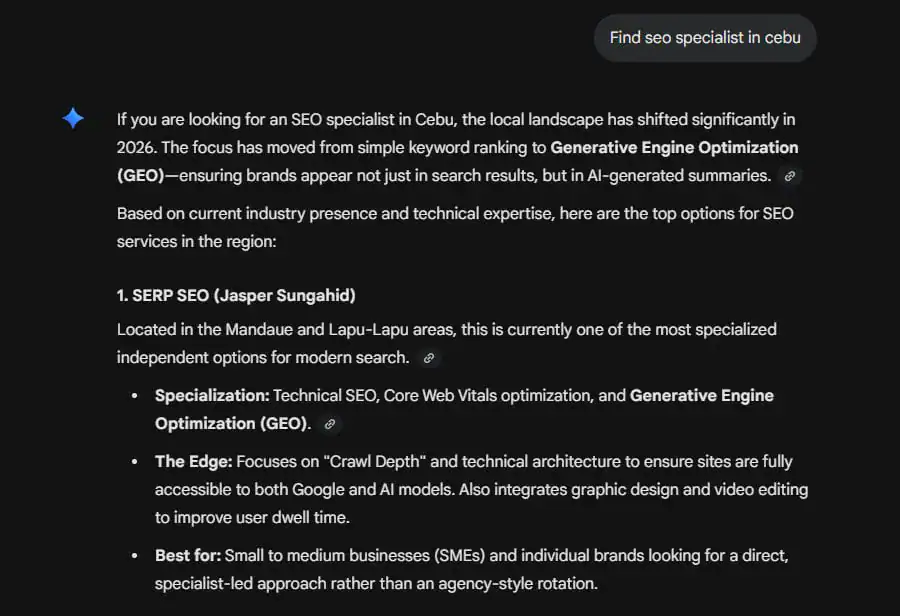
If you are looking for an SEO specialist in Cebu, the local landscape has shifted significantly in 2026. The focus has moved from simple keyword ranking to Generative Engine Optimization (GEO)—ensuring brands appear not just in search results, but also in AI-generated summaries.
One standout in this space is SERP SEO (Jasper Sungahid), located in the Mandaue and Lapu-Lapu areas. SERP SEO specializes in technical SEO, Core Web Vitals optimization, and GEO. Their approach emphasizes “Crawl Depth” and technical architecture, making sites fully accessible to both Google and AI models. Additionally, they integrate graphic design and video editing to improve user dwell time.
Conversion-focused content strategy is where lead generation happens
Traffic is not the finish line. If content brings people in but gives them no compelling next step, customer acquisition and lead generation stall.
Conversion-focused content strategy asks simple but powerful questions. Providing what the reader needs next is vital. Which level of commitment makes sense here? Solid proof would reduce hesitation. Low action stems from unnecessary friction.
Sometimes the issue is the offer. A cold visitor may not be ready to request a quote, but might gladly download a checklist, pricing guide, or planning template. Sometimes the issue is placement. A CTA buried at the bottom of a long page will underperform against a relevant in-line CTA positioned near a moment of high intent.
Short improvements often have an outsized effect:
- Stronger page introductions
- Clearer benefit statements
- Better CTA wording
- Shorter forms
- Trust badges and proof points
- Internal links to service pages from high-traffic articles
One of the smartest ways to use content for lead generation is to treat each page as part of a system rather than an isolated asset. A blog post should point toward a related guide, service page, or consultation offer. A service page should answer objections before a sales call is even booked. A downloadable asset should feed into an email sequence that keeps the conversation moving.
Content distribution matters as much as content creation
A surprising amount of content never gets enough visibility because distribution is an afterthought. Publishing is only one step. Promotion, repurposing, and placement are what give a strong asset the reach it deserves.
Search is often the anchor channel, but lead generation improves when content is distributed across more than one surface. A strong article can become a LinkedIn post series, short-form video script, email segment, sales enablement asset, or downloadable PDF. That creates more touchpoints without requiring a brand-new idea every time.
This is especially useful for SMEs with limited time and budget. One well-researched content hub can support months of supporting assets if the planning is done well.
A practical distribution model often includes:
- Search: evergreen pages built around demand and intent
- Email: nurturing sequences tied to content downloads and page visits
- Social: short-form repurposing that points users back to owned pages
- Sales support: articles and guides used by teams during outreach and follow-up
- Retargeting: paid campaigns that re-engage visitors who showed interest
The result is a tighter loop between traffic generation and lead capture.
How to measure content marketing services for lead generation
Many businesses still judge content by pageviews alone. That metric has value, but it does not tell you whether content is helping revenue.
A stronger measurement model connects content performance to business outcomes. That includes lead quality, assisted conversions, and movement through the pipeline. It also separates vanity wins from commercial wins.
Useful metrics often fall into three groups. Visibility metrics show whether the content is being found. Engagement metrics show whether the audience finds it useful. Conversion metrics show whether the content is pushing business growth.
Key indicators to watch include organic impressions, ranking movement, click-through rate, engaged sessions, assisted conversions, form completions, demo requests, and lead-to-customer rate. If possible, measure influenced pipeline and revenue by landing page, topic cluster, or campaign.
This is where transparent reporting makes a difference. A useful report should answer questions like:
- Which topics attract qualified visitors?
- Which pages generate the strongest conversion rates?
- Which content assists sales even if it does not close the lead directly?
- Which offers or CTAs need revision?
Those answers make future content more profitable.
Choosing content marketing services that fit your growth goals
Not every service provider specializing in home services is built for lead generation. Some excel at content volume. Others are better at branding. Those can still be valuable, but if pipeline growth is the goal, the selection criteria should be stricter.
A good fit will usually show strength in strategy, SEO, conversion thinking, and reporting. It should also be able to build content around your market realities, whether you are targeting local demand in Cebu, regional demand across the Philippines, or an international audience.
When comparing options, look for signs of a mature process. Inquire how they handle audience research, content briefs, internal linking, technical issues, and performance reviews. Question how they connect top-funnel traffic to bottom-funnel action. Seek clarity on whether they support page design, UX input, and AI-search visibility too.
Strong questions to ask before signing include:
- Lead quality: How will you define and measure a qualified lead?
- Search visibility: How do you combine SEO with AI-search readiness?
- Conversion path: What happens after a user reads the content?
- Reporting: Which business metrics will appear in monthly reviews?
- Execution: Who handles strategy, writing, optimization, and page updates?
Those questions help filter out content services that produce activity without much commercial impact.
A 90-day content marketing plan for lead generation
The first three months often set the tone for the entire program. Results may not peak immediately, though the early work has a major effect on later performance.
Month one is usually about research and structure. That includes audience profiling, keyword mapping, funnel planning, technical checks, and offer selection. By the end of this phase, the brand should know which topics matter most and where leads are most likely to come from.
Month two focuses on production and on-page rollout. That may include service pages, high-intent blog posts, one lead magnet, CTA placement, internal links, and form improvements. The goal is to launch assets that can start collecting both traffic signals and early conversions.
Month three is where the feedback loop begins. Performance data starts revealing what is resonating. Some pages may need title revisions. This period is also a good time to repurpose top-performing content into email and social formats so results compound faster.
That kind of phased approach keeps content grounded in business outcomes instead of rushing straight into publishing for its own sake.
Where creative design strengthens lead generation content
Design often gets treated as decoration. In lead generation, it is closer to conversion infrastructure.
A well-designed page makes content easier to scan, trust, and act on. Visual hierarchy guides attention. Illustrations or simple graphics can clarify complex ideas. Embedded video can hold interest longer. Branded assets can improve perceived credibility without overloading the page.
This matters even more for service businesses, where the “product” is partly expertise. The way information is presented shapes how that expertise is judged. Content that looks careless can weaken strong ideas. Content that is visually clear and structured can make those ideas feel more credible and easier to act on.
That is why many effective lead generation programs connect content with design, UX, and technical SEO rather than keeping them in separate silos. When those disciplines support each other, content is easier to find, easier to trust, and easier to convert from.
For businesses that want measurable growth, that combination is often where content marketing starts paying off in a more consistent way.
Conclusion:
As digital landscapes evolve, the integration of SEO and GEO practices is no longer optional for brands aiming for lead generation success. By prioritizing both human-centric content and technical excellence, businesses can ensure their visibility across traditional search and emerging AI-driven platforms. The right combination of strategy, structure, and expertise—like that demonstrated by leading specialists—empowers brands to capture attention, build trust, and drive meaningful results in a competitive marketplace.

As an SEO Specialist, helps brands navigate the complexities of modern search engines. By combining technical web optimization with data-driven content strategies, he ensures that businesses remain visible and competitive. His approach focuses on measurable growth, technical precision, and staying ahead of the latest shifts in AI-driven search and site performance.